

The Myth Of Pressure Testing
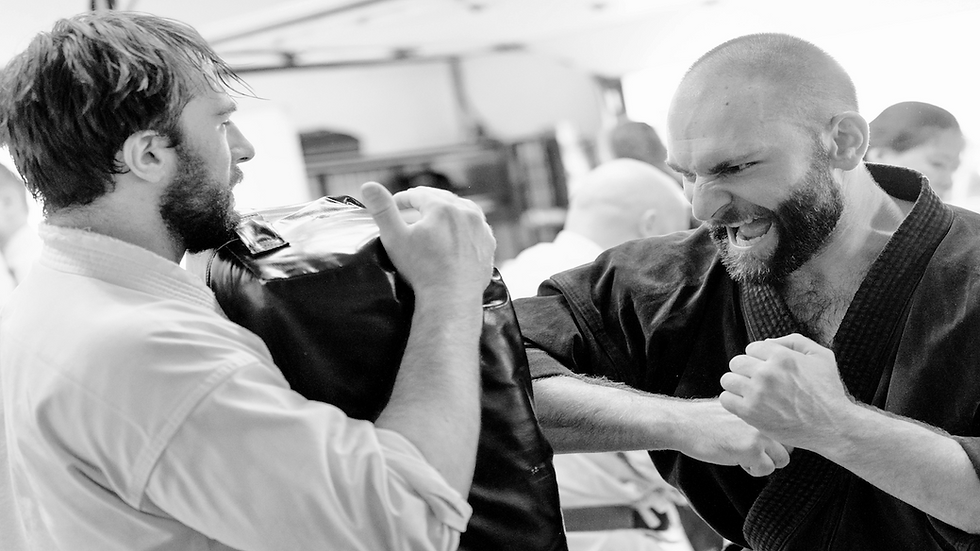
My young family and I lived in Clovis, New Mexico in 1990 as a result of my assignment to Cannon AFB. Now, Clovis is a lot like Ohio, except that it’s brown, hot, flat, has no trees, but does have a perpetual smell of manure emanating from the large stockyards there. Obviously, not one of my favorite assignments but two very important things happened at the time that changed my life. First and most important, my younger son, Andy was born there. Second, I had my first reality check in terms of martial arts training.
My first assignment in the Air Force was in Colorado Springs where I found and trained exclusively at The Academy Of Martial Arts. They offered classes in karate, judo and a derivative of Danzan Ryu Jujitsu and I was there five to six days a week. We sparred often; kickboxing was the norm then and while there were more rules than today’s MMA bouts, I have to tell you that I “got my clock cleaned" often. I’d say one of the most important aspects of my experience there was that I learned how to take hit. That’s invaluable for a serious martial artist.
When I was reassigned to Cannon AFB, I scoured Clovis for a martial arts school to continue training and found a small ad in the Yellow Pages…for those too young to know, we used to have these huge books with phone numbers in them that could also double for cinder blocks for things like changing a car tire. Anyway, the ad was for a karate school - Matsubayashi Karate Kenpo. The school was owned and operated by a local sheriff’s deputy, Waldo Casarvez, a fire plug of a man. Waldo was serious about two things: his job and his karate.
The first time I showed up at his dojo, I flaunted the fact that I had a black belt. And when I saw the archaic methods he used to teach sparring - he called it kumite - I was not impressed. No gloves, shin pads, foot pads. No mouth pieces and no goin cups. Waldo often mentioned that karate was not a sport; that it was about real close-quarter combat and he backed it up with the fact that he used his skills almost daily on the job. I can attest to that because I went on several “ride alongs” with him. I saw him pull a dude out of his car using a wrist lock that we call sankyo in aikido and he brought that 200 guy right down. Anyway…
The first time I sparred with Waldo, I quickly realized that I was the one sparring. He wasn’t. He never attacked, but waited for me to come in. And I had the tools and the youth to put up a good fight. Keep in mind, I participated in heavy sparring sessions a couple of times a week for four years straight. My first experience with Waldo was remarkable and scary. All he did at first was move a little and block — hard. Hard enough for me to think twice. When he did hit back, it was not punches to the face or the “sleeper” round house kicks I was used to. Rather, it was fingers to my eyes, strikes to my throat, low kicks to my pelvis, shins and knees. He would trap my arms and “simulate” breaking my elbow, or he’d simply grab my head and shove it to the ground. And the more aggressive and angry I got, the worse I got beat up.
Waldo wasn’t trying to prove his style worked. Nor did he approach me as an opponent. He applied simplistic, rudimentary techniques honed over decades of consistent training. Furthermore, he was in really good shape and scary strong. Most importantly, he wasn’t the least bit intimidated because he actually applied his skills daily. His pressure testing came in form of dealing with angry, mentally challenged, drunk or high people on the job. And he had to learn how to control them. Not go a few rounds to see who was better or to prove anything.
And that’s the difference between martial and fighting arts. Martial means “military.” It means combat. It means your life depends on your skills and that in turn dictates how you train. I don’t need to go a few rounds with an MMA fighter or NCAA wrestler (as a critic once suggested) to see if my technique is valid because I have no style to prove. And…I’ve already done that enough to know the difference. Now, I still encourage sparring with pads and people are free to take it to the ground. We also do a fair share of grappling. I think all of these skills and experiences are necessary. A committed punch in the face once in a while is extraordinarily educational. However…
A real fight happens when you least expect it; a road rage incident. A drugged out dude who walks up to you at the gas pump demanding money. It can happen in your home. Those are the kinds of circumstances you should be train for. No rules, no pads or boxing gloves. Nothing to prove. And that's why old school martial systems like karate, jujutsu, kung fu, aikido and others trained in “outdated” attacker-defender scenarios for centuries long before YouTube. Original martial arts were never meant to be competitive. They were meant to be quick and decisive.
Stop trying to defend your style. Focus instead on cardiovascular and muscular fitness. Be consistent in your training…one or two hours a week is not martial arts training…it’s a hobby. Find a school that incorporates sparring and aggression so you know what it’s like to face unscripted scenarios. And…don’t buy the hype.
Dave Magliano
Tatsu Dojo
Jissenkan Budo
Dojo Cho


Comments